
Today will be one of my favourite comfort foods: peas and beef stew with rice. It’s commonly known as basila wa roz = peas and rice. Appropriately named. It’s a very popular family meal; though you’ll rarely see it in a restaurant. It doesn’t exactly scream haute-cuisine. But peas and beef stew with rice IS a staple in just about every household.
Instant bonding over peas and beef
When I meet other Egyptians born outside the country, a few things immediately bond us: no Arabic, bastarma (cured beef) and basila wa roz. It’s just one of those staple dishes we all grew up eating and never thought twice about.
To my father’s credit, he even mastered it and was able to add that to his repertoire of home-cooked meals. That’s a total of two. He then went on to learn how to cook a whole turkey in the microwave. I don’t count that as meal #3 and neither should anyone else. Microwaves don’t count as cooking. Although between his version and my mother’s version of this meal, I kind of like his a bit better…sorry…Not because hers is not good; it’s great!
The difference lies in what makes up the liquid portion of the stew. My mother uses fresh chicken stock and my father uses water. I like the water because it lets the flavour of the tomato come through better. But her version is very comforting and flavourful. The tomato-base stew is nearly identical to that in bamya; except my version will use water and not chicken stock and there is no garlic.
Peas are no stranger to Egypt
The tomato-based stew is popular all throughout the Middle East, even though, as I’ve mentioned before, tomatoes were introduced to the area in the 1800s. Nonetheless, tomato-based stews reign supreme throughout the area.
Peas and rice, on the other hand, have been staples for centuries. Green peas originate from the Mediterranean basin and the Near East. One article I read said peas may either originate from China or Egypt, since they have been found artefacts in both places.
In Egypt, the charred remains of peas were found in Egyptian tombs from the 12th dynasty (1991-1783 BC). They were also found in the Nile Delta region dating 4400-4800 BC and in Upper Egypt from 3800-3600 BC.
So the green pea is no stranger to Egyptian cooking; but apparently it was never as popular as lentils. Instead, peas were dried and used during times of famine, which is how some other cultures also depended on them, like the European explorers who set off for the new world.
Rice….new addition
Rice made its appearance in Egypt around 4th century BC. At the time, India was exporting rice to Greece, which is probably how it made its way down to Egypt. With the fertile farming land in the Nile Delta, growing rice was easy enough. It’s still grown in that area today. So with peas and rice being in the area for so long, it’s no wonder they got together in a stew.
Add some protein, in this case beef, and you have the makings for a hearty stew. The flavouring of the tomato base combined with the allspice and cinnamon is really where the beef gets its taste.
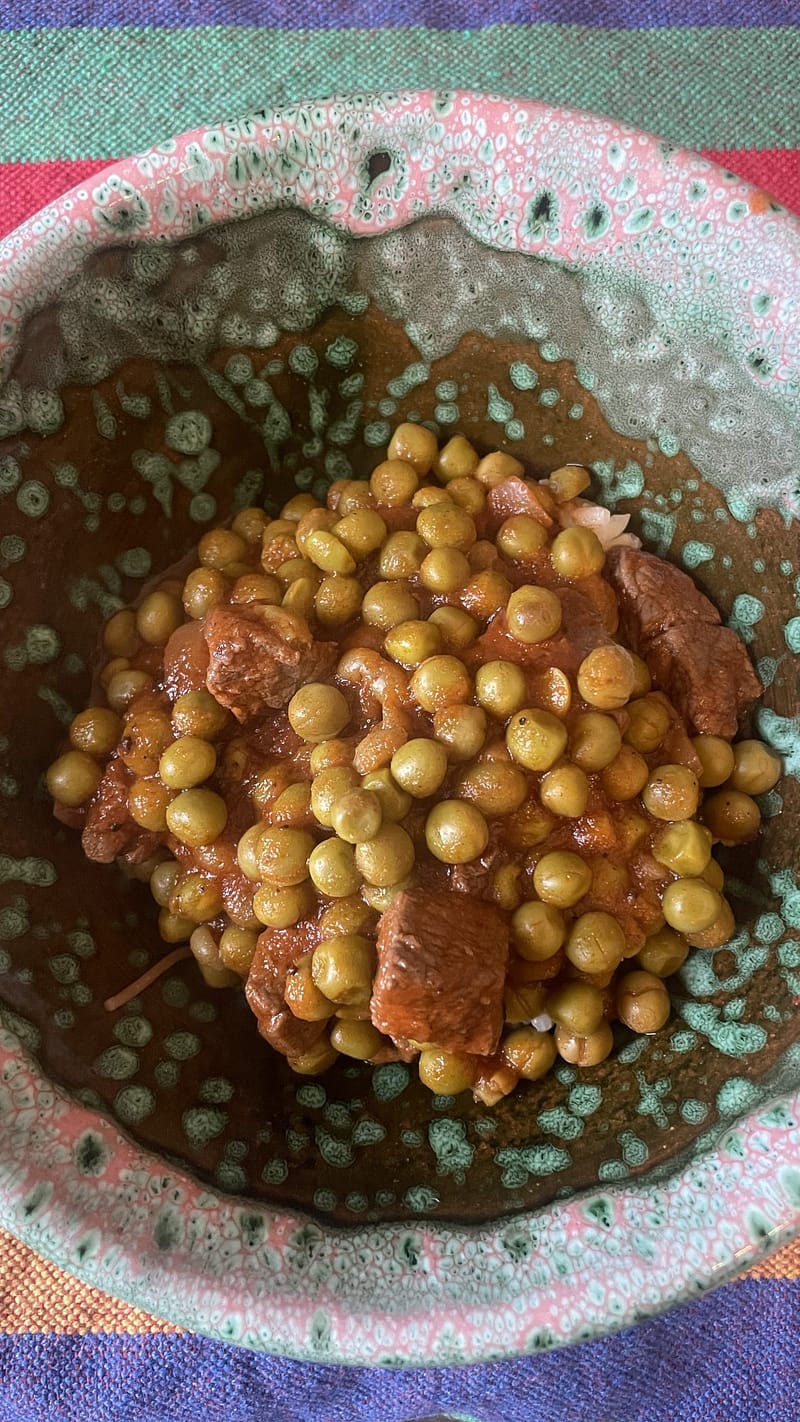
Egyptian stew: Peas and beef in tomato sauce with rice (Basila wa roz)
Ingredients
Stew
- 15 ml (1 tbsp) butter (or any neutral oil)
- 1 onion
- 500 g lean cubed beef
- 300 ml tomato paste
- 500 ml (2 cups) water OR chicken broth
- 290 g (2 cups) shelled peas (frozen or fresh)
- 1 cinnamon stick
- 2-3 grains allspice (ground)
- salt & pepper
- 14 g (1 tbsp) pine nuts (optional)
Rice
- 440 g (2 cups) rice (must be short grain, either Egyptian or Italian arborio)
- 500 ml (2 cups) water
- 14 g (1 tbsp) butter
- 18 g (1 tbsp) salt
Instructions
Stew
- Dice onion.
- In a stewing pot, heat oil and fry onions.
- When onions are soft, add beef.
- Brown beef for a few minutes until everything is seared on the outside.
- Add tomato paste, water, cinnamon, and ground allspice.
- Salt and pepper to taste.
- Let stew cook for about two hours; until meat is tender.
- When meat is tender, add peas.
- Let cook for another 15 minutes.
- (optional) Dry roast pine nuts in a hot pan until they turn golden.
- Add pine nuts as garnish.
Rice
- Measure out the rice and rinse the excess starch under warm water (water passing through rice should be clear).
- Add the water, butter and salt and set to high heat.
- Once the water is boiling, add the rice and stir.
- Cover the pot with a lid and set the heat to minimum. Check on it at least once to stir. It should finish cooking within 15 minutes.
