My mother asked me the other day what I was planning on making here for you and I responded proudly: “Kahk”. “Why?” she asked. “It’s too hard, and complicated. Make something easier!” Surprisingly, it’s a cookie that is not hard to make, and is well worth the time. And it’s a cookie that is so well-known and extends back so far in history that it would almost be a sin to not even try to explain what these cookies are all about.
Everyone remembers their first time eating Kahk
I remember my first kahk experience. It was Easter, I was about 16 years old, and we were visiting my father’s cousin in the morning. We were all given a little drink, some Tia Maria, I believe to toast for Easter. Right after, a box of these cookies came around.
They were all delicately wrapped in wax paper. My Uncle asked if I had ever had a kahk. I had no idea what he was talking about. He said these are special cookies that are only eaten at Easter or Christmas or any special occasion really. I took a bite and I was hooked.
Since then, I’ve noticed them everywhere. Bakeries in Canada, in France and back in Egypt. In the homes of my family and my friends. They are everywhere. And they are not hard to make. But why are they so popular?
Kahk: A muse for poetry
Apparently an Egyptian poet, Fouad Haddad, claimed: “Oh kahk, master of generosity … we will never stop making you.”
It’s a cookie that has its origins in Egyptian history from the days of the Pharaohs. And it’s a cookie that makes a yearly appearance for Egyptian Muslims to mark the end of Ramadan and bi-yearly for Egyptian Christians to mark Christmas and Easter. Basically, it’s a cookie to mark any major festival. And it’s a cookie that is so filling, that you only need one. It’s commonly called Kahk el-Eid, meaning a cookie of the feast.
Kahk: From snacks to amulets
Back during the days of the ancient Egyptians, these cookies were made as a snack. There are drawings in some of the Pharaonic temples in ancient Thebes and Memphis (close to Cairo) illustrating the making of kahk.
Oh kahk, master of generosity … we will never stop making you.”
Some drawings, also found on the walls of 18th century dynasty tombs show honey being mixed with butter over a fire. Flour is then added to make a soft and malleable dough. They would mould kahk into different forms or press them into elaborate flower or animal shapes.
They were often stuffed with dates and figs and embellished with dried fruits. The image of the sun goddess, Amon, would be added to the cookies. Larger kahk pies, known as shurik, were often made before visiting tombs during religious feasts. The idea being the pies served as amulets, thought to boost magical powers.
Kahk’s staying power
With the end of the pharaonic period, many of the rituals were kept intact through the Egyptian Christians. Kahk was still a popular ritual, but instead of adorning the cookies with Amon, an image of the cross was added.
However, the Amon sun-disc image made a come back when Islam spread into Egypt and the kahk-making was introduced into Muslim rituals. Regardless of the event, it’s usually made by groups of women who get together and whip these out. It is a delicate process, and each woman has her own secret for a successful kahk.
Outside of Egypt
Kahk, also extends into other Middle Eastern countries. The word ‘kahk’ means cookie or biscuit in arabic and can be found in the Levant as the same type of cookie but often made with semolina flour.
In other countries, such as Iraq, kahk is a doughnut style hard biscuit that is covered with sesame seeds and eaten as is or with tea. It is known as kahk bi loz, or almond bracelets. In the Gulf countries, kahk is known as mammoul, and is only stuffed with dates.
Don’t be put-off by any of the ingredients in this recipe. Kahk can come filled with dates (agameya), walnuts, pistachios, or simply not filled at all. It’s all a matter of what you want to do. I love all three, so I made all three fillings.
Easy-peasy
This is one of the easiest cookie doughs you will probably make. All recipes call for ghee (clarified butter) and butter. But since I’ve sworn it off, I opted for just pure butter instead, and it worked out wonderfully.
If you have access to a Middle Eastern food store, then you will be able to find the key ingredient: Mahlab. This is the seed of a sour cherry pit. It is a flavouring that is used in many sweets throughout the Middle East.
I used it for a brioche. The other key ingredient is called Rehet al-Kahk. This translates into the smell of Kahk. It sounds a bit complicated, but it’s just three ingredients blended together.
I bought it already mixed at the store, but if you can’t find it, it is equal parts of fennel seeds, anise seeds and mahlab. That’s the big secret. But if you don’t have any of that laying around, just use mahlab.
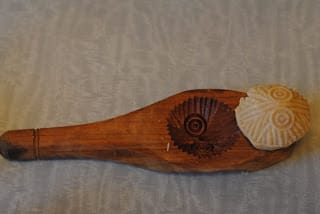
Another thing which is useful is a mould. I found a traditional one made out of wood in the mid-east food store.
If you can’t find one, don’t worry, just leave them as is, or use something around the kitchen like a fork to create a pattern. The trick to Egyptian cuisine: Don’t sweat it; just improvise.

Why you need more Kahk cookies in your life
Ingredients
Dough
- 500g (4 cups) Flour
- 300g (1.5 cups) Melted butter
- 1.5 tbsp Icing sugar
- 16g (2 heaping tbsp) Dry active yeast
- 100g (6 tbsp) Lukewarm water
- 1 tsp Kahk extract
- 1 tsp Mahlab *if no kahk extract, use 2tsp mahlab
Walnut stuffing
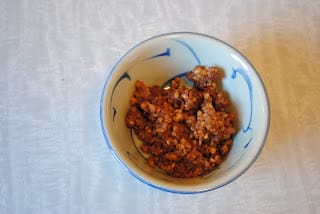
- 40g (1/4 cup) Chopped walnuts
- 1 tsp Cinnamon
- 3 tsp Icing sugar
- 1 tbsp Rose water
Pistachio stuffing
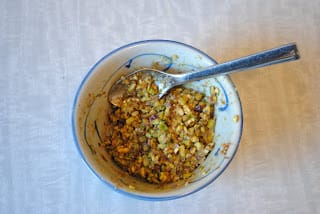
- 40g (1/4 cup) Chopped pistachios
- 3 tsp Honey
- 1 tbsp Orange blossom water
Date filling
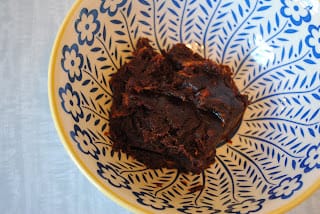
- 250g (1.5 cups) Dates (pitted and chopped yourself or bought already prepared)
- 25g (1/8 cup) Butter
- 1 tsp Cinnamon
Instructions
Walnut and Pistachio filling
- Add all ingredients to a chopper or food processor and set aside.

- The longer the nuts sit in its mixture with the fragrant water, the more flavourful the kahk will be.
Date filling
- Using a pan on medium heat, add butter.
- When melted, add the dates and cinnamon.
- Continue stirring until all the butter has been absorbed.
- If the date mixture still seems very dry, add a bit more butter.

Dough
- In a large mixing bowl, add the flour and butter.
- Mix together until the batter is lumpy and all the flour has been used.
- If you have bought unground mahlab seeds, you can grind them easily with a mortar and pestle
- Mix together the kahk and mahlab and sugar. (or just the sugar and mahlab).
- In a small container, add the lukewarm water. Make sure there is enough room (at least half) for the yeast mixture to rise.
- Add the kahk mixture and yeast to the water.
- Keep the mixture loosely covered and at room temperature for at least ten minutes.
- When the mixture has at least doubled in size, (about 15 mins) add to the flour mixture.
- Mix using hands until all the ingredients have been worked in and it is a ball of dough.
- Set oven to 190C (375F)
Filling the kahk
- Grab a handful of dough and shape into a ball. Don't worry so much about the size, but more about the consistency. Each ball should be roughly the same size.
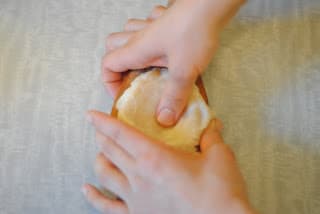
- If you are using a mould like this, then press the dough into it, making a little dip in the middle to put the filling.
- If you are not using a mould, use your thumb to create a little dip in the dough to add the filling.
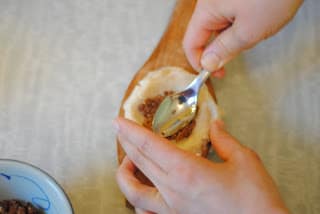
- Add about a teaspoon of any filling of your choice.
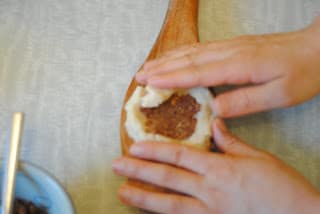
- Pinch the side pieces of side together to cover up the filling.
- Lay on a non-greased baking sheet. Or you can use parchment paper.
- Bake for 15 minutes or until golden in colour.
- Take out and set aside to cool before dusting with icing sugar.