
Ah ha! I bet you all thought I’d never write again, or that I had run out of recipes. Well, perhaps more likely the latter. But the truth is life has been in the way for the past two years (almost exactly to the day). Added to that is the fact that I really wasn’t inspired by many of the recipes in my collection. I went to Egypt a few times in between, and found a few things… but nothing felt worthy enough to share with you.
That being said, today is day ? (I’ve lost count) of our lockdown in France and worldwide. And I’m sure many of you are killing time by sharpening your culinary skills, so why not make cake? As Marie Antoinette famously said: “Let them eat cake.”
And so we shall.
The Legacy of Samira (Tante Ri-Ri)
Now, sponge cake does not exactly convey images of the sun-drenched country of pyramids as the warm breeze of the Nile blows the desert sands around. This recipe is actually a well-known one in our family made famous by my maternal grandmother Samira, or Tante Ri-Ri as she was affectionately called.
None of us in our generation ever met her, but her legacy lives on as one of the best cooks, bakers, illustrators, and photographers. My two maternal first cousins are the ones who brought this cake to my attention. After a video baking show-and-tell that spanned three countries, I now have THE recipe!
Thankfully, my aunt was on the other line guiding the preparation of the cake. The ingredients are simple. My grandmother used to add cinnamon for flavour, or you can add lemon peel/juice or whatever you want. I opted for a chocolate topping – a favourite recipe from my paternal aunt.
On the Hot Trail of Sponge Cake
But sponge cake? Again, how is it a family recipe in Egypt? Let’s look at the origins of sponge cake.
I’ll be the first to admit, it’s not Egyptian or Middle Eastern in its character. I mean, there’s no butter… and just about everything has some butter base in the desserts.
According to Bakerpedia, a site that has all kinds of rare facts on baked goods, sponge cake was born during the Renaissance in Italy. Italian cooks baked these sponge “biscuits” which spread across the territory (Italy wasn’t yet united) and then through England and France.
It was only in 1615 when the recipe itself was recorded by the English poet and author Gervase Markham. Up until this point, however, the cake really looked more like a cookie: thin and crispy.
How the Sponge Got Its Bounce
During the mid-18th century, the idea of beating the eggs became part of the process, and that in turn created a spongy batter. When baked, the airy batter turns into a raised cake without any other ingredients. And hello, sponge cake as we know it happened!
The Egyptianisation of European Classics
Fast forward to the English presence as of 1882, and the growing Italian community that followed from that time up until the end of the Second World War, and we have two communities from where the sponge cake likely originated.
Many Egyptian families have these European recipes lurking in their repertoire: sponge cake, petit fours (shortbread cookies), or bâton salé (breadsticks) to name a few. But over time, they have become egyptianised and passed down from generation to generation. And so, this is ours.
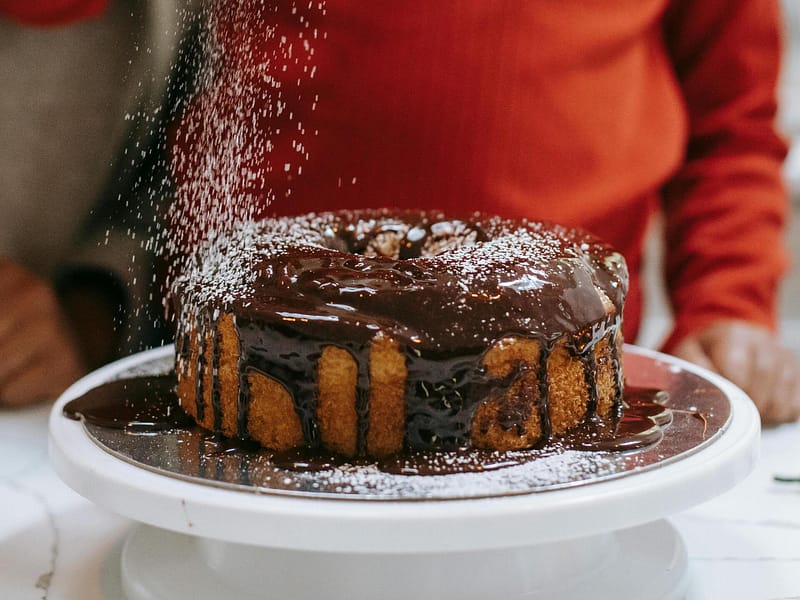
Traditional Egyptian Sponge Cake
Ingredients
Sponge Cake
- 9 eggs
- 400 g / 2 cups sugar
- 250 g / 2 cups plain (all purpose) flour
Chocolate Sauce (Optional)
- 85 g / 0.5 cups sweetened baking chocolate
- 1 tbsp milk or cream
- 2 tsp rum or liquor of choice
Instructions
Make the sponge
- Preheat the oven to 175°C (350°F).
- Crack the eggs into a large bowl.9 eggs
- Whisk until the mixture turns pale and light in colour.
- Gradually add the sugar and continue whisking until the batter looks airy and fluffy.400 g / 2 cups sugar
- Slowly fold in the flour, taking care not to knock out the air from the batter.250 g / 2 cups plain (all purpose) flour
- Pour the batter into a non-stick cake tin, or a tin lightly greased with butter.
- Bake for 30–50 minutes, depending on your oven. Do not open the oven door during baking, as this may prevent the cake from rising properly.
- The cake is ready when a knife inserted into the centre comes out clean.
Make chocolate sauce (optional)
- Melt the chocolate gently.85 g / 0.5 cups sweetened baking chocolate
- Stir in the milk (or cream) and rum until a thick, smooth sauce forms.1 tbsp milk, 2 tsp rum
Serve
- Serve the cake plain or drizzled with chocolate sauce.
