
I’ve been trying to chase down this recipe for months now. Though I ate it back in 2010 for the first time during Christmas dinner in Cairo. I thought it was molokhia a green soup made from the fresh leaves of the molokhia plant. Not at all, though the spicing is similar.
I was told it was ‘olass. And that it is normally eaten on special occasions, like Christmas. But after some research between both sides of the family, and my Arabic tutor, turns out everyone eats ‘olass all the time and its a favourite dish of most households.
A childhood deprived of taro
We never had it at home. When I asked my mother the reason, without missing a beat she scrunched up her face and explained: “I hate that dish, I never liked to eat it.” And hence, a childhood deprived of taro root.
My aunt, on the other hand, reminisced with my father on this and said my grandmother made this dish often, but couldn’t remember how. My father had little recollection of liking or disliking it, which means it wasn’t a favourite, but it was tolerated as part of the usual repertoire of weekly meals. In his own words, it’s good, but “it’s no molokhia”.
What is olass?
But what is it? It’s taro root cut into chunks, boiled in water, then thrown into a mix of swiss chard and spices. That’s it. It’s not a dish, however, that you’ll find in restaurants or on the streets. It’s really at home that this is eaten.
Religious traditions and the epiphany rhyme
The prime time for this dish among Christian households is especially during Epiphany, which comes at the end of Christmas. If you want to get into religion, it’s the time when Jesus was baptised – plunged under water for purification purposes.
The idea of eating taro, which has to be boiled in water before it’s edible, is representative of Jesus’s baptism. (Fun fact: raw taro contains calcium oxalate, which will make your mouth go numb, so raw taro is in fact toxic!)
In fact, there’s a little rhyme my aunt said would often be heard by children around that time of year: “Eid el ghotass, yakul ‘olass”, which literally translates into: “At the festival of Epiphany, one eats taro.” Clever!
Taro’s global journey: From India to Egypt
But taro is eaten in all households, regardless of religion. The root itself grows in Egypt after it spread via cultivation from its origins somewhere in India.
Taro is a popular root found in many African dishes and, with the trans-Atlantic trade, made its way into the Americas, where it is also popular in many Caribbean and South American countries. The true name of taro is Colocasia, and in Arabic ‘qulqass’. In Egypt, because we shorten words when possible, it’s known as ‘olass, or ‘ulass.
Swiss chard: The essential green
Swiss chard – in Arabic “salq” or “sal'” in Egyptian Arabic – grounds the taro root to a tasty base. The vegetable is often referred to as “silverbeet” or “whitebeet” because it is related to the beet family. The “Swiss” adjective comes from a Swiss botanist who studied the plant.
But the plant itself is native to the southern Mediterranean region, namely Sicily. According to articles I consulted, Aristotle apparently mentions it in his writing, so it has a place in ancient Greek history as well. Swiss chard likely found its way into Egypt via the Ancient Greeks or the Romans later on. Either way, the plant itself is not native to Egypt, but it thrives there now.
A family recipe treat
And after all my extensive research, it was my cousin (an amazing cook) who sent me THE recipe. It’s likely a mix of our family’s traditional one coupled with her ingenious additions. So, you’re in for a treat.
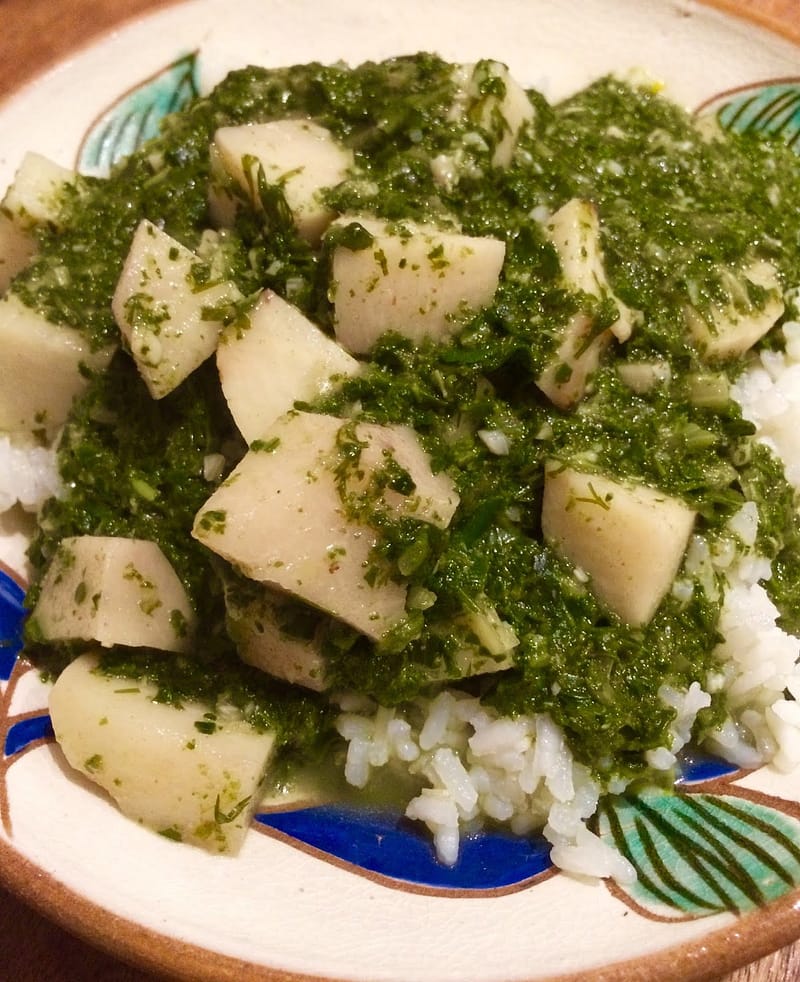
Olass wa sal: Egypt’s way to always eat your greens
Ingredients
- 7-9 taro roots
- 1 head swiss chard
- 1 handful fresh coriander (cilantro)
- 2-3g (1 tbsp) fresh dill
- 5 garlic cloves chopped
- 14ml (1 tbsp) oil
- salt to taste
- 3g (2 tsp) ground coriander seeds
- 14g (1 tbsp) butter
- 475ml (2 cups) broth (stock) chicken or vegetable
Instructions
Prepare the taro
- Peel the taro roots and cut them into cubes.7-9 taro roots
- Add the taro to a pot of salted boiling water.
- Cook over medium heat for about 20 minutes, until soft.
- Drain and set aside.
Prepare the greens
- Slice the Swiss chard into thin strips.1 head swiss chard
- Finely chop the dill, coriander and garlic.1 handful fresh coriander (cilantro), 2-3g (1 tbsp) fresh dill, 2.5 garlic cloves
- Heat the oil in a pan and sauté half of the garlic with the Swiss chard, dill and coriander.14ml (1 tbsp) oil
- Season lightly with salt.salt
- Stir until the greens are soft and have significantly reduced in volume.
- Remove from the heat.
Make the taqliya
- In a separate pan, dry-roast the ground coriander until it begins to change colour.3g (2 tsp) ground coriander seeds
- Remove from the heat, then add the butter and remaining garlic.14g (1 tbsp) butter, 2.5 garlic cloves
- Stir gently over low heat until the butter is absorbed and the mixture becomes fragrant.
Blend and assemble
- Add one to two ladles of broth (stock) to the cooked chard mixture and blend until smooth.475ml (2 cups) broth (stock)
- Transfer the purée to a pot and add the remaining broth (about 9–10 ladles). The consistency should resemble a thick soup.
- Add the cooked taro and the taqliya.
- Simmer gently on low heat for 10 minutes, without letting it boil.
Serve
- Serve hot with plain rice.
