
When I first began writing recipes for this site (formerly a blog), I was constantly asked if and when I would put up a recipe for koshary. I had stayed away from it because, well, I never ate it much. In fact, long before my blogging days, when it was all the rage to circulate top ten lists of “you know you’re Egyptian/Indian/Canadian etc. when….” the Egyptian one was always funny to me because it listed obvious things like how much we love our raw onions and garlic, to how many times a day an Egyptian mom would call her children. But there was always one that got zero reaction out of me: “All you ever eat is koshary”. I never got it. I asked my parents, and they always replied with a blasé explanation about it being some kind of food. So what is it??
Koshary, the non-Egyptian national dish, well what is it?
On a trip to Egypt in the early 2000s, I was set on learning what this koshary was. I read up on it beforehand and had a good a idea what it was: Egypt’s answer to fast food. And it really is fast food. It’s essentially street food, that is good for you, and can be assembled together in no time.
The famous Abou Tarek restaurant in downtown Cairo is sort of the leader in this since that’s all it serves. You walk in and the men working there stand behind their bowls of rice, brown lentils, pasta, and fried onions.
They quickly scoop it out into a disposable bowl layering all the ingredients and topping it off with the onions. A tomato-garlic-chili sauce is added to flavour by each person. This is what people have been raving about. And in all honesty, it hits the spot when you’re starving. And it’s yummy.
It’s the type of dish that can be eaten for a quick lunch when at work, or dinner when you can’t bothered to make anything else. Or you just want a satisfying snack. It’s also a meal that has become quite popular amongst the Coptics in Egypt who often do no-animal fasts; so this is a dish that is both filling and vegetarian/vegan friendly. It is regarded as a runner for one of Egypt’s national dishes.
Koshary’s true non-Egyptian roots
Nothing in it or about it is actually Egyptian. It is known to be a popular peasant meal, with all the ingredients readily available and for very cheap. However, I did come across one article which explained a great possible source of its origin: India.
To begin with, rice is not native to Egypt. Rice was introduced to Egypt back in 1000 B.C. probably through the Persians who learned about rice through trade with South East China. Secondly, the tomato sauce used to season dish is made up of tomatoes and chili, both originating from the Americas.
The only ingredients native to Egypt in this dish are the lentils and onions. So how did this dish come to Egypt? Well, according to one source, we need to think back to the time of British colonization. The British army had been living in India since the late 1700s, they then came to Egypt in the late 1800s.
The word ‘koshari’ is not an Arabic word. In fact, it is a Hindi word, ‘khichri’ meaning a dish of rice and lentils. It is an Indian street food that the British army took a liking to; probably because it is cheap, very filling, and above all safe to eat.
They brought this dish with them to Egypt and I guess it became quite popular. Just as a side note, many places do serve this dish with chickpeas in addition to all the other ingredients. But this is a newer addition, and is entirely optional.
All this to say that koshary is a dish that has now become so well integrated into Egyptian food that the origin itself seems to have been lost along the way. But, like many other foods that have found their way into Egyptian households, it is well-loved and simple to prepare, and tells much of the country’s history in one bite.
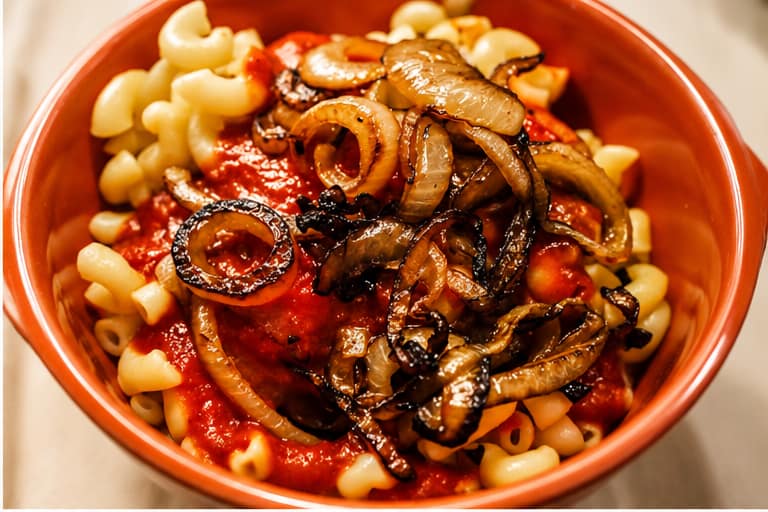
Koshary, the non-Egyptian national dish
Ingredients
- 340g tomato paste
- 118ml (1 cup) water
- 118ml (1 cup) white vinegar
- 4 cloves peeled garlic
- 1-2.5g (1 tsp) dry chili flakes/or fresh chili (to taste)
- 1-2.5g (1 tsp) ground cumin (to taste)
- 28g (2 tbsp) melted butter or oil
- 320g (1 1/2 cups) short grain rice
- 320g (1 1/2 cups) dry brown lentils
- 100g (1 cup) short elbow pasta (or any short pasta)
- 1 sliced onion
- * 165g (1 cup) cooked chickpeas (optional)
Instructions
- In three separate pots, boil enough water to cook the rice, lentils and pasta.
- While these are cooking, chop up or smash the garlic.
- In a small pan, heat up the olive oil/butter on high heat.
- Add garlic and lower the heat.
- Once the garlic begins to soften up, add the vinegar, and then stir.
- Add the tomato paste and mix until everything is uniform.
- Add just enough water to the sauce to the consistency is of a pasta sauce (i.e. not too thick but not too runny like soup).
- Add chili and salt to taste.
- Once the sauce has picked up the chili and garlic flavours, set aside.
- When rice and lentils are done cooking, mix them up together and set aside.
- Drain the pasta and set aside.
- Slice the onions and fry them in oil/butter until they are crispy.
Assemblage
- Using a bowl, add a generous layer of rice/lentils.

- Follow with a layer of pasta.
- Now add some of the tomato sauce all over.
- Top it with some fried onions, and (if you're doing chickpeas) some chickpeas.

