
Dukkah (Egyptian spice mix) is a beloved staple in many households in Egypt. Its fragrant combination comes from the roasted sesame seeds, coriander seeds, and cumin seeds. The Levantine region has its own mix, called Za’tar. Over the years, I’ve had many requests about this cherished and little known spice mixture . In Egypt, the word dukkah is commonly pronounced as du’ah. The word derives from the Arabic word to pound, since the spices are toasted and then pounded using a mortar and pestle.
Dukkah (Egyptian spice mix) takes its place of honour
To be honest, I never gave du’ah much thought, it was just always something sitting in the fridge. My father, however, has always been obsessed with it, and up until recently I couldn’t figure out why. But every time we sit down to a dinner of pasta, he whips out this massive jar of du’ah and instead of grating some parmesan cheese, he proceeds to flood his pasta with mounds of this spicing. Or he simply eats it just as it is with a spoon.
My daughter has now taken up this tradition of sitting at the table with just a spoon and a bowl of du’ah. Another toddler in the family also picked up this habit. Is it genetics? Or is it simply they know a good thing when they have it?
Dukkah (Egyptian spice mix): Far too many varieties
The problem with buying this ready-made is that because it is a mix of spices, there are many, many variations. To minimise disappointments at the dinner table, my father used to replenish his stock back home after each visit to Egypt. His cousin used to have connections to someone who excelled in this delicate balance of spices.
Apart from its use in pasta, we never used it for any other purpose at home. Although, growing up my father said how my grandmother and her friends would all get their du’ah from the same person, or one of them from the group would make a big batch for everyone. Either way, it was kind of a big deal getting your fill of du’ah. At home, she would use it for sandwiches, just sprinkling some on the bread to give it a pop of flavour before adding meats or cheeses.
‘Caviar of the poor’: Dukkah (Egyptian spice mix)
The popularity of du’ah is waning somewhat among middle and upper class Egyptians. It was commonly used by those living in poverty as a way to stave off hunger: a healthy blend of spices to dip bread into and you’ve got yourself a relatively filling meal.
Going back to the generation of my parents and grandparents, it was found all over. Yes, more popular in the poorer areas, but it was also sought by many households. The difference being the richer households bought their du’ah from someone, whereas the poorer ones made their own. In a way, as someone framed it to me, it was the ‘caviar of the poor’.
During the late 1990s and early 2000s (it might still be there), if you went down to midan (square) Ramses in downtown Cairo, you could find du’ah sellers. According to my cousin who went to school not far from there, he and his friends would receive a little cone of paper filled with du’ah and a little ghee (samna) in a small bowl, so you could add the spice mix into it. Then you could tear off a piece of fresh bread and dip it into the du’ah.
Hard to beat a good snack
I went to some hipster bar in New York City a few years ago, and on the ‘ethnic’ menu for starters was du’ah (dukkah) with warmed pita bread and olive oil. I ordered it and while it wasn’t awful….the combination of the spices was off. But I’ll admit, hipster joint aside, it was refreshing to see an item like that on the menu, even if the server herself had no idea about the dish.
In fact, it is commonly eaten in Egypt as a starter with some warm pita bread (some mix it with olive oil). So the hipster bar wasn’t wrong after all. It’s also used during fasting season (any religion) as a light way to break the fast. While most households have a stash of it, it’s not the ubiquitous spicing mix used for an array of dishes as one would see with za’atar in salads or Lebanese-style pizzas (manoush).
I personally think it’s heavenly with eggs: omelette, scrambled, fried, boiled…doesn’t matter. They’re just a match made in heaven!
A mixing of history in one spoonful
The different spices used in the mix sort of throw all of the country’s history into one even blend.
While the mix differs from person to person, at the base of it are: sesame seeds, cumin seeds, and coriander seeds. These are all items that can be traced back to the times of the pharaohs.
Sesame
Sesame seeds are not native to Egypt, but have a long history there. Originally this ancient seed was grown in Indonesia, but it soon found its way through trade to Asia, the Middle East, and parts of Africa, such as Egypt. From here, the seed spread to other parts of the world. In ancient Egypt, the sesame seed wasn’t just used for cooking but also in rituals and food offerings to the gods as the Pharaohs believed it held magical powers.
Coriander
Coriander seeds have a long culinary use in North Africa, the Middle East, Asia and Europe. They are mentioned in Sanskrit literature going back to 5000 B.C. In Egypt, their use goes back to the days of the Pharaohs. In fact, coriander seeds were found in the tomb of Ramses II. The ancient Egyptians referred to coriander seeds as the “spice of happiness”, possibly because it had aphrodisiac qualities.
Cumin
Cumin seeds were originally grown in Iran and the Mediterranean basin. According to one source, cumin is mentioned in both the old and new testament of the bible. But prior to that, the oldest reference to cumin dates back 5000 years to the days of our friends the Pharaohs, where it was an ingredient in mummification.
Peanuts
While hazel nuts or peanuts are used as the main nut in the mix, the mixture normally has peanuts. However, neither nut is native to Egypt. Peanuts originate from South America and were brought over by the European explorers and eventually traded around the Mediterranean. Hazel nuts can be traced back to Syria, Turkey, and even further back to China. So the nut component of the mix is a relatively new addition, and highly optional!
The best thing about this mix is that the flavouring comes from its dry roasting. That means it’s about as healthy as you can get and it can keep for a very long time.
Thank you Marley!
The recipe I am sharing with you is one from father’s first cousin, Marley. She’s one of the few whose opinions on food matters ends all conversations. Her mother, Renée (Tante Renée to me) was the Queen of tasty and light cooking in the family. So it’s only natural that one of her daughters carries on the tradition.
I finally got a chance to ask Marley for the recipe and was astounded by how easy it is. She omits the nuts because it’s a nuisance (I agree). The recipe is all about ratios, so don’t take the measurements to heart.
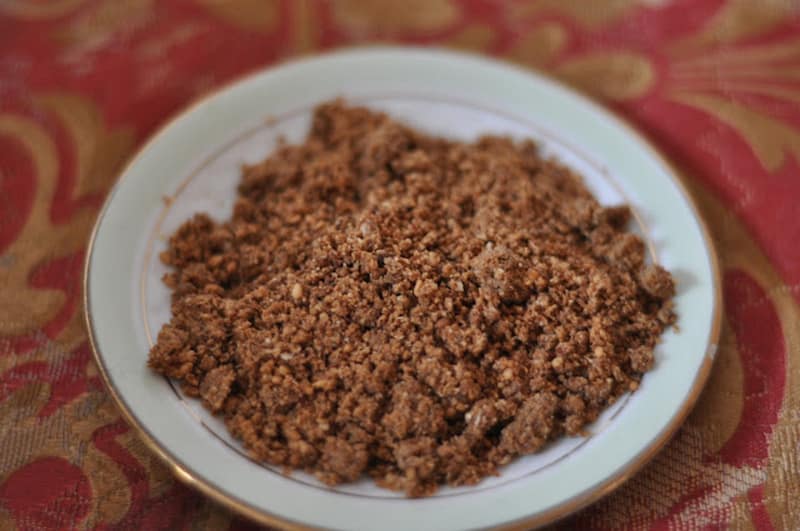
Better than Zatar? Yes, it’s Egyptian Du’ah (dukkah)
Ingredients
- 2 cups (or anything similar in size) Sesame seeds
- 1 cup (or similar size) Coriander seeds
- Handful Cumin seeds
- Sprinkling to taste Salt
- (optional) 1.5 cup (or similar in size) Powdered peanut (or hazelnut)
Instructions
- Using a frying pan, dry roast on medium heat the sesame seeds until they slightly change in colour. Golden is what you want.
- Set the seed aside and add the ground peanuts (or other nuts) if you are using them.
- Once the ground nuts have slightly changed colour, put them aside. Add the coriander seeds.
- When the coriander seeds start to smell fragrant (they may pop here and there, don't worry about that), set them aside.
- Add the cumin seeds and roast until they start to smell fragrant.
- Mix all the roasted ingredients into one bowl.
- Let the roasted spices cool down.
- Depending on the size of your spice grinder, grind spoonful by spoonful until you attain a uniform and powdery texture.
- Once the mix has been ground, add some salt to taste.
- Add into a closed container and keep in the fridge or even in the spice cupboard.
