
It’s that time of the year: fava bean season. And by fava bean, I mean broad beans. Not the beans used in ful mudammas. This is the bigger, louder cousin of the bean family.
All throughout the Mediterranean basin, fava beans are on display. Each country has its own approach to eating them. In Portugal, they are used to make hearty stews; in France, they are eaten fresh or thrown into salads. And in Egypt, they are pureed into a lovely dip called Bissara (pronounced: beess-awe-ra).
A tale of two Bissaras
Beware! A similar type of dish and name exists in Morocco of Berber origin, but it is more of a soup. One could deduce that Bissara, which has its origins in the Pharaonic era, made its way across the Sahara to Morocco. The Egyptian version is different, though – thick, green, and vibrant.
Simple yet efficient
Bissara is a mezze dish, but more for breakfast, especially if you’re in the rural areas. You eat this and you’re good for the day. It’s a similar approach to the ful mudammas meal. You eat this and you’ve got your proteins and carbs for the day; it sits like a stone in your stomach.
But it’s a very popular mezze dish in the cities too. Most restaurants will have it on their menu. So what is it? It’s quite simply mashed fava beans with fresh herbs, mixed with some seasoned oil. Boom! There you go. It’s really the base for making Egyptian falafel (taameya) but with different seasoning.
Ancient origins: Old world agriculture
The broad bean became domesticated in the Near East some time around 3000 BC. Or possibly even earlier, as one source cites charred remains in Neolithic sites in the Levantine region, marking the domestication of the crop to as early as 8250 BC.
Egyptians, Romans, Greeks… they all had the perfect growing environment for it and thus have been consuming it for centuries. It’s considered to be “Old World Agriculture”. Regardless, it’s one of the most ancient plants in cultivation, likely because it’s one of the easiest to grow.
While the word “Bissara” likely stems from the Coptic word peeseowor, meaning cooked and mashed beans, there’s no hard evidence that this particular dish was eaten in ancient Egypt. However, all the ingredients – fava beans, dill, coriander, parsley, garlic, and cumin – grow in abundance naturally in Egypt.
A traditional staple for fasting and countryside life
It’s a very popular dish among the Coptic community during the times of fasting (over 250 days), when they have to stay away from animal products. You normally eat it before a main meal or as a snack.
It’s also a very inexpensive meal to prepare, making it a popular dish among the poorer Egyptians, especially in the countryside where these ingredients are readily found. Here, Bissara is often eaten as a full meal. You can put it in the same category as ful mudammas, and really, if you look at the ingredients, it’s the precursor to taameya!
From the farm to the city
As is the case with many peasant dishes, mass urbanisation in the early to mid-20th century saw this dish make its way into the big cities. It is now a staple in many restaurants when you order your mezze, or appetisers.
Growing up, this was definitely not a dish we had at home, or even when eating out in Egypt. It was quite off the radar for our family on both sides. But it was at the insistence of my cousins there that I try this dish. So I did. And not only that, I offered it to my nine-month-old baby who devoured it!
Making the most of springtime fava beans
When springtime hits, the markets are chock-full of fresh fava beans. I’ve always been at a loss as to what to do with them. But now… now I can tap into my roots and whip out this golden number. It’s fresh, it’s healthy, and it’s very filling.
The secret: The tasha
The secret to making the flavours blend together beautifully is the tasha. The oil, similar to molokhia’s taqliya, is a mix of chopped garlic, ground cumin, and ground coriander seeds. Together they make the blandest of fava beans shine.
Fresh vs. dried beans
The recipe I did uses fresh beans, but dried fava beans are just as easy to use – they just take a bit more time to prepare. I will include instructions for both.
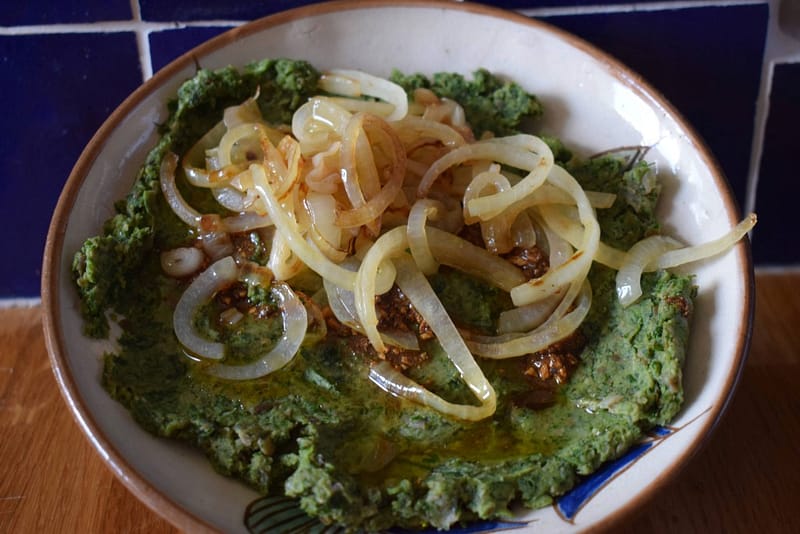
A healthy, vibrant green mezze topped with crispy onions.
Ingredients
- 500 g / 2¾ cups dried fava beans or 1kg fresh fava beans
- 1 onion (red or white)
- 1 handful fresh parsley
- 1 handful fresh dill
- 1 handful fresh coriander (cilantro)
Tasha (seasoned oil)
- 2 tbsp olive oil
- 4 garlic cloves, crushed
- 1 tsp ground coriander seeds
- 1 tsp ground cumin
Instructions
Cook the beans
- If using dried fava beans, soak them overnight. Drain, then cook in salted water with half the onion (cut into quarters) for at least 1 hour, or until very soft.500 g / 2¾ cups dried fava beans
- If using fresh fava beans, shell them and cook in salted water with half the onion for about 20 minutes, or until tender.
Blend
- Drain the cooked beans and transfer them to a large mixing bowl.
- Add the fresh parsley, dill and coriander.1 handful fresh parsley, 1 handful fresh dill, 1 handful fresh coriander (cilantro)
- Blend using a food processor or hand blender until smooth.
Make the tasha
- Heat the olive oil in a small saucepan over low heat.2 tbsp olive oil
- Add the garlic, cumin and ground coriander, stirring continuously.4 garlic cloves, crushed, 1 tsp ground cumin, 1 tsp ground coriander seeds
- Heat until fragrant, but do not allow the oil to bubble or burn.
Fry the onion
- Slice the remaining half of the onion and fry in a pan until golden.1 onion
Assemble
- Spoon the blended beans into a serving bowl.
- Pour the spiced oil over the top and finish with the fried onions.
Serve
- Serve warm with pita bread.
