
Oh sweet mother of god is this dish amazing. Before I delved into making it, I had put it off fearing it was a difficult one. It’s not. It’s actually much easier to make than it looks and it tastes as amazing as the first time I tasted it. Trust me, you’ll love this. And a bonus, it’s creamy without any dairy products.
But Sharkaseya, Circassian walnut chicken, you ask? Ah yes….
During one visit to Egypt years ago, I strayed away from our usual go-to restaurants and came across a few memorable ones. One in particular had this dish on its menu. We all tried it and couldn’t get enough of this dish.
I then began to notice it on other menus. What really made it click for me though in terms of its place in Egyptian cuisine was while I was reading Naguib Mahfouz’s Cairo Trilogy. In the first book, set during the late teens early twenties in Egypt of the 20th century, the reader is brought to the home of a typical, middle class muslim family living in Cairo.
Without turning this into a literature review entry, one of the sons is married off to a woman from a very ‘respectable’ family, in that she is of Turkish descent, and thus lighter in colour, more European features, and ultimately privy to the culinary recipes of her people. While her mother-in-law is not so much a fan of her, she manages to win over the household with her Circassian chicken meal…a dinner that ordinary Egyptians rarely get to taste in their lifetime, yet alone in their own home.
How Circassia and walnuts met Egypt
Let’s not forget that Egypt was under Ottoman rule for nearly 400 years. And the Ottoman empire stretched as far east to the Caspian sea, which included the region of Circassia. In fact, the region was well-known for its beautiful women, many of whom were married (by force) to the Ottoman Sultans and Persian Shahs.
Walnuts themselves, originate from Persia, so it’s easy to see how the nut got swept into regional cuisines.
When the Ottomans took over Egypt, many of its influences soon became part of Egyptian culture, including the food. As with other recipes I’ve written about, this is one of the ones that is not rooted in traditional and local ingredients, but it has a big place in terms of historical and cultural significance.How did Circassian walnut chicken enter the repertoire of Egyptian cuisine you ask? Simple. The Ottomans.
Let’s not forget that Egypt was under Ottoman rule for nearly 400 years. And the Ottoman empire stretched as far east to the Caspian sea, which included the region of Circassia. In fact, the region was well-known for its beautiful women, many of whom were married to the Ottoman Sultans and Persian Shahs.
Walnuts themselves, originate from Persia, so it’s easy to see how the nut got swept into regional cuisines.
When the Ottomans took over Egypt, many of its influences soon became part of Egyptian culture, including the food. As with other recipes I’ve written about, this is one of the ones that is not rooted in traditional and local ingredients, but it has a big place in terms of historical and cultural significance.
Blank stares
I asked around my family for a proper recipe for this dish, and I either got blank stares or warnings of how difficult it would be to prepare. Meh…I found a recipe and modified it to the taste I remember and through research in terms of its ingredients.
Many of the recipes I came across did call for mastic, known as arabic gum, that originates from the greek island of Chios, but found its way to Egypt since the Pharaonic times. When used in cooking, it gives a pine-tree flavour.
I opted to not include mastic in this recipe because it’s hard to find in stores, and is not an ingredient most people will have readily available in their homes. Also, I don’t think the pine-tree flavour adds much to this recipe.
It’s a dish that can be prepared in a relatively short amount of time, and keeps for a few days afterwards. So don’t worry too much if the portions seems large. You can either cut the recipe in half, or eat it, for a long time.

Food of the gods: Sharkaseya, aka Circassian walnut chicken
Ingredients
Broth
- 1 whole chicken OR 7-8 cleaned chicken breasts
- 3 cloves crushed garlic
- 1 onion peeled and quartered
- 1 cinnamon stick
- Handful salt & whole pepper
- water
Sauce
- 300g (2.5 cups) shelled walnuts
- 40g (1/3 cup) flour
- 4.5g (2 tsp) ground allspice
- broth from chicken
Instructions
Broth
- Add chicken, garlic, onion, salt, pepper, and cinnamon stick to pot.
- Add enough water to cover chicken (or chicken breasts).
- Leave to cook for about 60 minutes, or until the chicken or chicken breasts are fully cooked and broth is flavourful.
Sauce
- While chicken is cooking, ground allspice if you have whole grains.
- Grab a small frying pan and add flour on medium-high heat. Keep the pan dry, so no fat.
- Keep stirring flour to avoid from burning.
- Once flour starts to change colour, add ground allspice.

- Continue to keep stirring until spice mixture changes colour to a light brown.
- Take off heat and set aside.
- In a food processor or large bowl, add flour/allspice mixture.
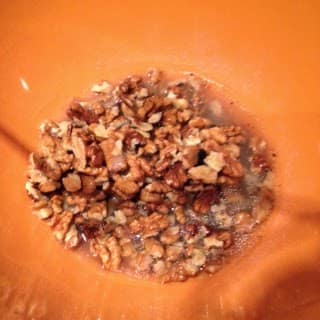
- Add walnuts.
- Add one cup of broth to begin with.

- Purée mixture until it is fully blended and has a creamy texture.
- Keep adding small amounts of broth until you get the texture of a creamy sauce.
- Once sauce is done, set aside.

Assemblage
- Take off all of the meat from the chicken, taking sure to avoid any bones or cartilage. Or if using chicken breasts, pull the meat.
- In a large serving bowl, add all the chicken meat.
- Add sauce on top of chicken and mix.
- Serve chicken and sauce with rice and some cooked greens or salad.
